The Cybersecurity Industry Is Finally Talking About What We've Been Telling Clients for Years
If you've followed Cybersecurity news lately, you've probably noticed three topics dominating the conversation:
- AI governance and acceptable use
- AI-powered cyber threats
- Increased demand for cybersecurity leadership, compliance oversight, and virtual CISO services
For many organizations, these developments may feel new. For us, they feel familiar.
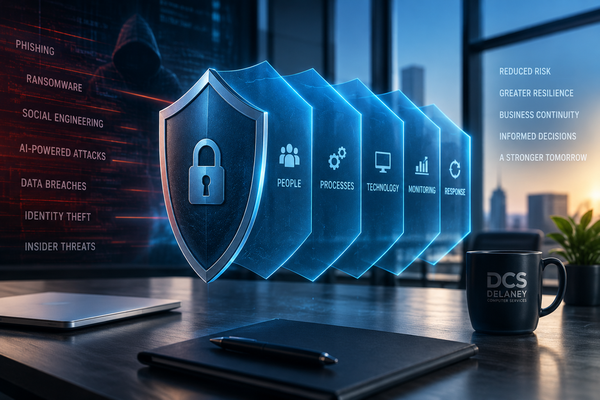
Delaney Computer Services has always approached cybersecurity as a layered defense strategy built on sound processes, informed decision-making, and disciplined risk management. No single product, control, or platform can eliminate risk on its own. Effective cybersecurity comes from combining multiple layers of protection, understanding where the organization is exposed, giving leadership the information needed to make informed risk decisions, and pushing back when a proposed course of action creates unnecessary or unacceptable risk.The technology changes. The principles don't.
AI Didn't Create Governance Problems. If you think about it, AI is exposing them.
Artificial intelligence has quickly become one of the most discussed technologies in business. Employees are using AI tools to write emails, summarize documents, generate content, analyze data, assist with research, write code, and automate routine tasks.
The problem isn't necessarily the tools themselves.
The problem is that many organizations are discovering they never had clear policies governing how they should use, share, protect, or review sensitive information in the first place.
Today, businesses are asking important questions:
- Can employees use AI tools for work?
- Which AI platforms are approved?
- What company, customer, or confidential information can be shared with AI systems?
- How does AI affect client confidentiality and data privacy?
- What are the regulatory and compliance implications?
- Who is responsible for reviewing AI-generated output?
- Who is accountable for how AI is deployed and used?
These are governance questions, not simply technology questions.
The National Institute of Standards and Technology addresses this issue directly through its AI Risk Management Framework and its companion guidance for generative AI. NIST emphasizes governance, risk identification, oversight, measurement, and ongoing management as core components of responsible AI adoption.
In other words, deploying AI safely requires much more than choosing a platform and purchasing licenses.
Organizations need to understand what information AI systems can access, how employees are using them, what risks those tools introduce, and who is responsible for managing those risks.
This is also where AI governance and managed AI services become increasingly important. Businesses need policies that define acceptable AI use, safeguards for confidential information, processes for evaluating new AI platforms, and controls designed to reduce the risks tied to Shadow AI, where employees use unapproved AI tools without organizational oversight.
For years, we've helped clients develop technology policies, define acceptable-use standards, evaluate business risk, and establish accountability for technology decisions. Organizations with strong governance practices are generally better positioned to adapt to AI than those trying to create controls only after employees have already adopted the technology.
The Threat Landscape Has Changed. The Fundamentals Have Not.
Artificial intelligence is also changing what cybercriminals can do.
Attackers can use AI to improve Phishing campaigns, automate reconnaissance, create more convincing SOCial engineering attacks, generate malicious content at scale, and impersonate trusted individuals using synthetic audio, video, and other forms of generated content.
Microsoft's Digital Defense Report describes attackers using techniques ranging from AI-automated phishing to increasingly sophisticated social engineering and identity-based attacks.
That sounds new, and some of the technology certainly is.
But look closely at how many successful attacks still begin.
A user clicks a phishing link. >> A password is stolen.>> An account is compromised.>>A system hasn't been patched.>>Someone is granted more access than they need.>>Suspicious activity isn't detected quickly enough.>>A company discovers that its incident response or recovery plan doesn't work when it is finally needed.
The tools available to attackers may be evolving, but the defenses that matter most remain remarkably consistent:
- Strong identity and access management
- Phishing-resistant multi-factor authentication
- Cybersecurity awareness training
- Endpoint detection and response
- Continuous security monitoring
- Vulnerability and patch management
- Email and cloud security
- Incident response planning
- Reliable backup and Disaster Recovery
- Business Continuity planning
These aren't new concepts. They're foundational cybersecurity controls we've recommended and implemented for years.
For example, modern managed cybersecurity services increasingly need to protect much more than computers and firewalls. Businesses now depend heavily on cloud identities, Microsoft 365, SharePoint, OnEDRive, SaaS applications, remote access systems, and other cloud-connected platforms.
That expanded attack surface makes layered security more important, not less.
Services such as cybersecurity awareness training, managed endpoint detection and response, identity protection, and continuous cybersecurity monitoring remain critical because AI-enhanced attacks are still attempting to exploit people, identities, devices, applications, and security weaknesses.
Organizations that focused on cybersecurity fundamentals before AI became a headline topic are generally in a stronger position today than those looking for a single product, platform, or AI-powered security tool to solve every new risk.
Cybersecurity Leadership Is No Longer Optional
Another major shift we're seeing is increased demand for strategic cybersecurity leadership.
Organizations are recognizing that cybersecurity is no longer solely an IT issue.
It is a business risk issue.
It is a compliance issue.
It is an operational resilience issue.
And increasingly, it is a governance and executive leadership issue.
Many small and midsized organizations don't need a full-time Chief Information Security Officer.
What they do need is experienced guidance and clear accountability.
They need someone who can help leadership understand cybersecurity risk, establish priorities, evaluate compliance obligations, oversee remediation efforts, develop policies, evaluate vendors, review security controls, and communicate effectively with auditors, regulators, insurance carriers, customers, and other stakeholders.
This is one of the reasons virtual CISO, or vCISO, services and cybersecurity governance services continue to become more relevant to small and midsized organizations.
A vCISO helps bridge the gap between technical cybersecurity controls and executive decision-making.
Instead of simply asking, "Which security product should we buy?" leadership can begin asking better questions:
- What are our most significant cybersecurity risks?
- Which risks should we address first?
- Are our existing controls actually working?
- Are we meeting our regulatory or contractual obligations?
- Who owns each cybersecurity responsibility?
- How do we demonstrate due diligence?
- What happens when a security incident occurs?
For organizations subject to regulatory or contractual cybersecurity requirements, that leadership becomes even more important.
DCS provides managed compliance services designed to help organizations evaluate requirements, implement appropriate administrative and technical safeguards, develop policies, track remediation, and maintain an ongoing cybersecurity compliance program rather than treating compliance as a once-a-year exercise.
Cybersecurity maturity isn't achieved simply by installing more technology. Someone must be responsible for connecting cybersecurity controls, governance, compliance obligations, business priorities, and organizational risk.
Being "Ahead of the Curve" Isn't About Predicting Headlines
There's a misconception in our industry that being ahead of the curve means constantly chasing whatever technology happens to be generating headlines.
In reality, long-term success usually comes from consistently applying proven principles while adapting thoughtfully to change.
We've seen the same pattern again and again.
Cloud computing changed where businesses stored their information.
Remote work changed where employees accessed it.
Ransomware changed how attackers monetized access.
Compliance requirements changed how organizations were expected to document and manage cybersecurity risk.
Artificial intelligence is now changing how employees work, how businesses automate processes, and how attackers operate.
Each development introduces new risks and requires organizations to adapt.
But none of them eliminate the need for sound governance, strong security controls, accountability, risk management, and continuous improvement.
At Delaney Computer Services, we've never viewed cybersecurity as a collection of products. It's an ongoing risk-management discipline built around people, processes, technology, accountability, and continuous improvement.
The cybersecurity industry may be focused heavily on artificial intelligence today, and rightfully so.
But when we look past the headlines, the conversation keeps coming back to the same fundamentals we've been helping clients address for years:
- Understand your risks.
- Establish accountability.
- Implement strong controls.
- Monitor whether those controls are working.
- Continuously improve.
- Make technology decisions that support the long-term success of the organization.
The trends may change. The mission doesn't.
Need Help Strengthening Your Cybersecurity Strategy?
Delaney Computer Services helps small and mid-sized organizations manage technology risk through cybersecurity services, managed cybersecurity, managed compliance services, AI governance, and virtual CISO services.
If your organization is evaluating its cybersecurity posture, AI policies, compliance obligations, or overall technology risk, contact Delaney Computer Services to discuss where your current controls are strong, where gaps may exist, and what should be prioritized next